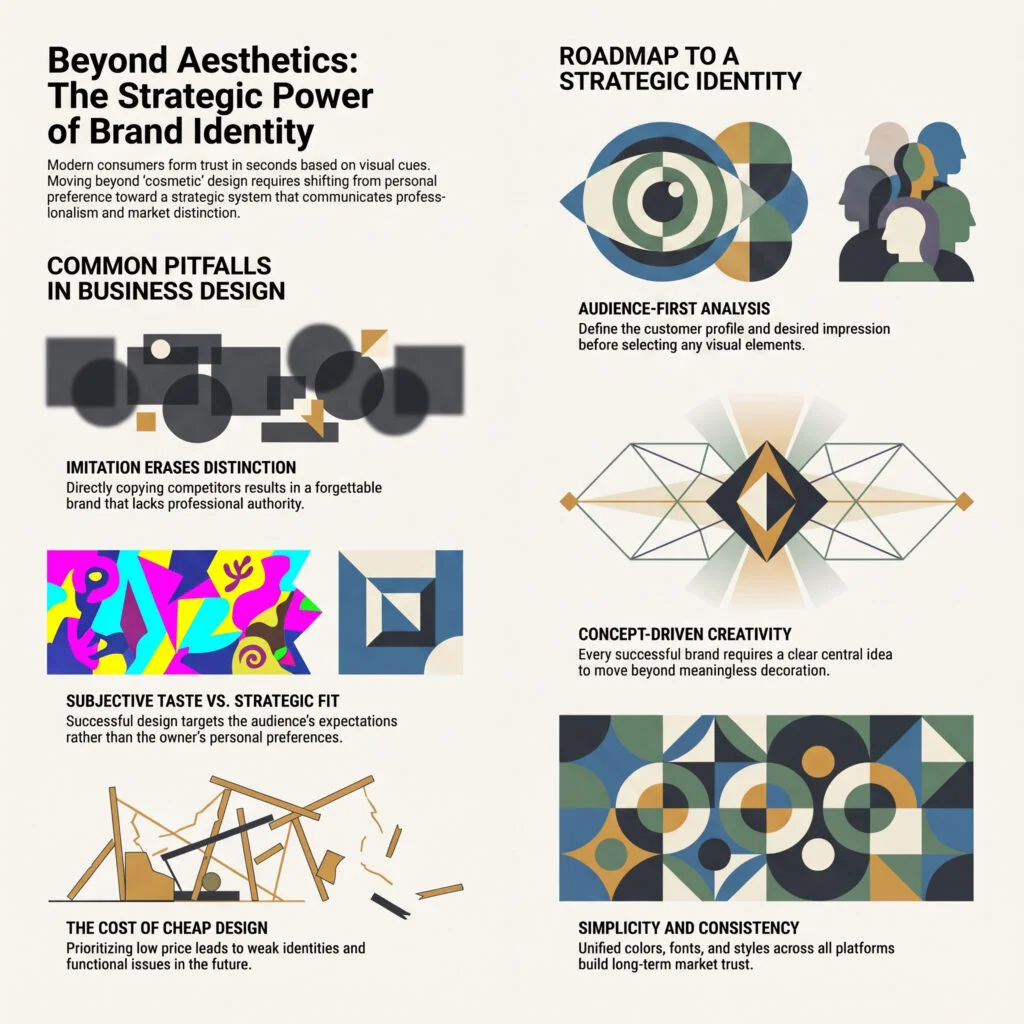

Many business owners still treat design as a secondary or purely aesthetic step, while in reality, visual identity has become a core part of any successful brand.
Today, customers form their first impression within seconds, and in many cases, they decide how trustworthy a business feels before even trying the product or service itself.
The Most Common Mistakes Businesses Make
1. Copying Competitors
One of the biggest problems in today’s market is visual repetition.
Many brands rely on copying successful competitors or recreating trendy ideas without building a unique identity that reflects the real personality of the business.
The result:
- Weak brand recognition
- No clear differentiation
- An unprofessional or generic appearance
2. Choosing Design Based Only on Personal Taste
Good design is not about what the owner personally likes.
It should be based on:
- The target audience
- The type of business
- Brand positioning
- Pricing level
- Customer expectations
What works for a luxury restaurant may completely fail for a youthful fashion brand or a modern tech startup.
3. Prioritizing Low Cost Over Quality
Looking for the cheapest design solution often leads to:
- Weak visual identity
- Poor consistency
- Generic branding
- Long-term usability problems
Professional design is not just a logo.
It is a complete visual system that helps businesses build trust and communicate value.
4. Focusing on Execution Without Strategy
There is a major difference between someone who simply creates graphics and someone who builds a strategic brand identity.
Strong branding starts with:
- Understanding the business
- Analyzing the market
- Defining the audience
- Building a clear visual direction
Only after that should colors, typography, and design styles be selected.
How to Choose the Right Design for Your Business
Understand Your Audience First
Before thinking about visuals, businesses should ask:
- Who is the customer?
- What kind of experience do they expect?
- What impression should the brand create?
Strong branding speaks the language of its audience, not only the preferences of the business owner.
Build a Clear Concept
Every successful brand is built around a clear idea or personality.
Without a concept, design becomes nothing more than visually attractive elements without meaning or identity.
Keep It Simple and Consistent
The strongest visual identities are usually based on:
- Clarity
- Consistency
- Well-planned colors
- Appropriate typography
- A unified visual style across all platforms
Overcomplicated branding often becomes forgettable and ineffective.
Work With a Strategic Designer
A professional designer should not only ask:
“What colors do you like?”
They should also understand:
- Your business goals
- Your market position
- Your audience behavior
- The image you want to build
Conclusion
Design is no longer a luxury or an optional visual enhancement.
It has become a direct part of how businesses build trust, attract customers, and position themselves in competitive markets.
In a market full of similar-looking brands, strong visual identity is often the difference between a business that gets ignored and one that leaves a lasting impression.